Table of Contents
- Dwarkadhish Temple Architecture
- History of Dwarka
- Temple Structure & Shikhara
- Underwater Dwarka & Marine Archaeology
- Archaeological Evidence from the Coast
- Dwarka in Hindu Scriptures
- Reading the Temple Layers
- Museum and Plaque Stops
- On-Ground Reading Tips
- Underwater Dwarka Claims — What Archaeology Actually Shows
- Nawabi Repairs and Solanki Core
- Reading List Before You Land
- Compare with Somnath
- Local tip from our editor
- Common mistake
- Verify before you go
This guide covers Jagat Mandir architecture, scriptural history, and underwater archaeology in detail; for overview see Dwarka guide.
Few places blend mythology, history, and archaeology the way Dwarka does. Hindu scripture describes it as Krishna's golden kingdom, built by Vishwakarma. Today the Dwarkadhish Temple carries that legacy above ground, while marine surveys off the coast have turned up submerged structures that may — or may not — belong to the legendary sunken city. Here's how the story reads from temple architecture to underwater finds.
Dwarkadhish Temple Architecture
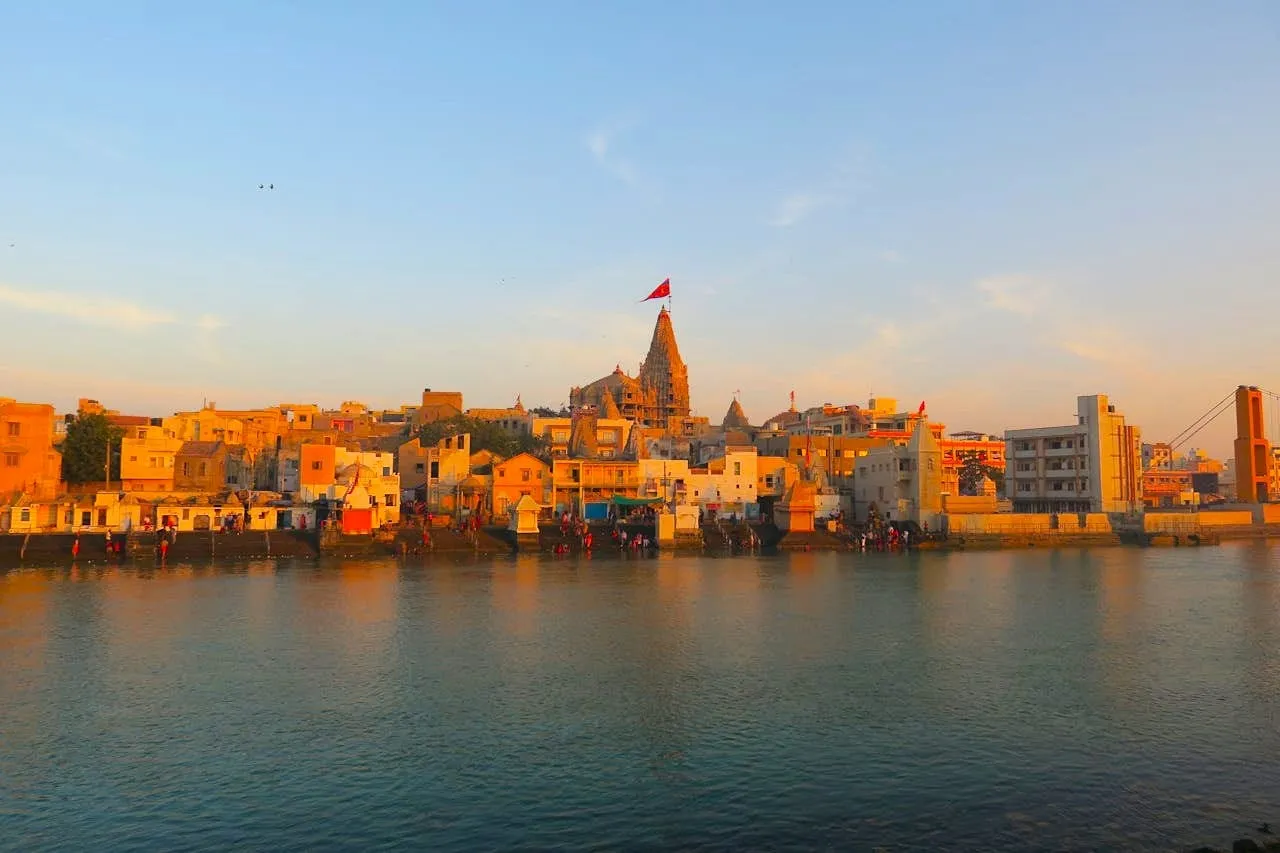
The Dwarkadhish Temple — Jagat Mandir, "the temple of the world" — is Dwarka's defining shrine. Tradition says Vajranabh, Krishna's great-grandson, built the original around 2,200 years ago on the spot where Krishna's palace stood. The structure you see today dates largely to the 16th century, rebuilt with support from the Gaekwads of Baroda and the Acharyas of the Vallabha and Nimbarka sampradayas.
Built of soft limestone, repaired over centuries, it's a fine example of medieval Hindu temple architecture. Two main entrances: Moksha Dwar (Gate of Salvation) to the north, Swarga Dwar (Gate of Heaven) to the south — 56 steps down to Gomti Ghat. The sanctum holds Dwarkadhish in four-armed form with shankh, chakra, gada, and padma.
History of Dwarka
The Mahabharata, Harivamsa, Bhagavata Purana, and Skanda Purana describe Krishna establishing Dwarka after leading the Yadavas away from Mathura to escape Jarasandha. At Krishna's request, Vishwakarma built a magnificent city on Gujarat's western shore — golden palaces, gardens, temples, and a harbour that welcomed ships from across the world.
When Krishna completed his earthly mission, tradition says the Arabian Sea swallowed the city. That legend has held devotees and scholars for centuries — and it's still central to Dwarka's identity as Krishna's capital.
Temple Structure & Shikhara
The five-storey shikhara (spire) is the temple's most striking feature — 78 metres high, supported by 72 carved pillars. A flag with sun and moon symbols crowns it, changed five times daily by devotees who climb 56 steps. The 72 pillars recur in both temple lore and architectural study.
Devotees traditionally bathe at Gomti Ghat before climbing Swarga Dwar's 56 steps. The complex holds shrines to Balarama, Devaki, Vasudeva, Rukmini, and others — each adding another layer to Jagat Mandir's sacred geography.
Underwater Dwarka & Marine Archaeology
Hindu tradition says the Arabian Sea reclaimed Dwarka after Krishna's departure. Modern expeditions by the ASI and National Institute of Oceanography have found submerged stone structures, ancient anchors, pottery, and man-made walls and pillars at 20–40 metres depth off the coast.
Exact dating and origin are still debated, but the finds lend weight to ancient accounts of a lost Dwarka — and have made the city fascinating to archaeologists as well as pilgrims.
Archaeological Evidence from the Coast
Excavations and underwater surveys near Dwarka and Bet Dwarka have turned up stone blocks, pier remains, and artefacts pointing to ancient coastal settlement and port activity. Onshore digs found pottery and structural fragments from several periods. Researchers are still working out whether these belong to Krishna-era Dwarka or later maritime civilisations.
Bet Dwarka island and the Okha coastline are key survey zones. If archaeology interests you, combine darshan with ASI publications and coastal sites where onshore evidence has been documented.
Dwarka in Hindu Scriptures
Dwarka appears in the Mahabharata, Harivamsa, Bhagavata Purana, Vishnu Purana, and Skanda Purana as Krishna's capital — a city of unmatched grandeur. The name comes from Sanskrit "dvar" (door/gateway), the gateway to moksha. Scriptures describe Vishwakarma's construction, Krishna's rule, and the city's submergence.
Beyond the Puranic narrative, Dwarka sits among the Char Dham and Sapta Puri — frameworks that place it at the centre of Hindu pilgrimage geography. Whether you come for history, faith, or archaeology, the scriptural Dwarka and the living temple tradition are inseparable.
Reading the Temple Layers
Jagat Mandir's present form blends centuries of patronage — Chalukya-era elements, later Maratha and regional repairs, and living ritual spaces that were never frozen as a museum. Walk the outer prakaram before entering the sanctum: stone bands, lotus motifs, and the tall shikhara profile change character in early morning sidelight. Compare the mainland Dwarkadhish Temple with the simpler island shrine at Bet Dwarka on the same trip — pilgrims often notice how court versus home narratives shaped scale and ornament. Nearby Swaminarayan Mandir and ISKCON Temple show 20th-century stone craft in dialogue with the ancient core, useful if you want a half-day architecture walk without leaving town.
Museum and Plaque Stops
Small displays near the temple belt and Bet Dwarka jetty interpret excavated pottery and anchors — pair them with this history read for context on trading-era Dwarka versus Puranic Dwarka. Ask at Jagat Mandir information counters for any temporary exhibition during festival weeks.
On-Ground Reading Tips
Spend ten extra minutes on the outer prakaram before entering the sanctum — morning sidelight reveals stone bands and lotus motifs best. Compare mainland Jagat Mandir with the simpler island shrine at Bet Dwarka on the same trip. Small displays near the temple belt interpret excavated pottery — pair them with this article for context. ASI publications on marine surveys are available online if you want depth beyond the temple visit.
If marine archaeology interests you, read ASI summaries before visiting — onshore displays at Bet Dwarka jetty add context to submerged-structure headlines. Allow 45 minutes for outer prakaram study at Jagat Mandir before joining the sanctum queue.
Evening floodlighting on the shikhara changes the silhouette — worth one exterior pass after Sandhya aarti if photography interests you. Compare scriptural Dwarka with the trading-port evidence at Bet Dwarka jetty displays on the same trip.
For overview see Dwarkadhish Temple. Stand at the west facade before 9 AM and you can read five construction phases in the stone colour shifts — later Nawabi repairs sit beside older Solanki-era carving bands our guides rarely mention unless asked.
Underwater Dwarka Claims — What Archaeology Actually Shows
Marine surveys off the coast found structured stone — walls, anchors, pottery — not a fantasy city intact on the seabed. I treat underwater Dwarka as layered history: scripture, oral tradition, and science in conversation. The archaeology blog goes deeper; on the ground, the museum plaques near the temple are worth ten quiet minutes.
Nawabi Repairs and Solanki Core
The shikhara profile you see today layers Maratha and later repairs over older Solanki stonework — compare column bases east vs west facade. Museum near temple (when open) shows excavated fragments; ₹10–₹25 entry typical. Allow 45 minutes with a guide if history is your main lens for Dwarka.
Reading List Before You Land
Bhagavata Purana Dwarka chapters, ASI pamphlets on coastal excavations, and temple trust history boards — together they frame what you see beyond gold kalash photos. Spend 20 minutes on exterior before joining queue — architecture rewards slow eyes.
Compare with Somnath
Somnath reconstruction style differs — visiting both on coastal itinerary highlights how Dwarka retains older stone fabric at base levels.
Local tip from our editor
If you want this history article to help on the ground, read it before visiting the temple exterior and then spend ten extra minutes noticing the stone layering, shikhara profile, and carved bands instead of rushing straight inside. Early or late daylight reveals those details far better than noon.
Common mistake
Readers often treat architecture as background information and miss the visible clues that make Dwarka feel older and more layered than a simple temple stop.
Verify before you go
Check whether exterior access around the monument is open and if any repair or crowd-control barriers are limiting close viewing.
Plan Your Dwarka Trip
Written by
Lead Editor & Pilgrimage Guide · Independent Dwarka travel guide
Last updated: June 9, 2026
We verify temple timings, routes, and fares against notice boards and recent pilgrim reports. See our editorial policy.