The Story of a Sacred City
About Devbhumi Dwarka
Krishna's ancient capital on the Arabian Sea — a Char Dham site where scripture, archaeology and living temple tradition come together.
Dwarka, revered as Devbhumi Dwarka — the Land of the Gods — is one of the most ancient and sacred cities in India. According to Hindu scripture, Dwarka was the magnificent capital established by Lord Krishna after he led the Yadava clan away from Mathura. The name "Dwarka" derives from Sanskrit dwar (gate or doorway) — the gateway to moksha (liberation).
Dwarka in Hindu Scriptures
Dwarka appears prominently in the Mahabharata, Harivamsa, Bhagavata Purana, Vishnu Purana and Skanda Purana as Krishna's capital and a city of unmatched grandeur. Scriptures describe Vishwakarma's divine construction, Krishna's rule, and the city's eventual submergence after his departure. Beyond Puranic narrative, Dwarka is listed among the Char Dham and Sapta Puri — frameworks that place the city at the centre of Hindu pilgrimage geography.
Dwarka and Char Dham
Dwarka is one of the four holy Char Dham pilgrimage sites established by the 8th-century philosopher-saint Adi Shankaracharya, alongside Badrinath in the north, Puri in the east and Rameswaram in the south. Completing the Char Dham yatra is considered a lifelong spiritual aspiration for Hindus, and Dwarka is the western pillar of this sacred circuit. The Dwarkadhish Temple anchors the living tradition of this pilgrimage today.
Dwarka as One of Sapta Puri
In the Sapta Puri tradition — the seven cities believed to grant moksha — Dwarka stands alongside Ayodhya, Mathura, Haridwar, Varanasi, Kanchipuram and Ujjain. The pilgrimage is not limited to the main temple: Bet Dwarka, Gomti Ghat and Rukmini Temple are part of the same sacred geography.
Archaeological History of Dwarka
Onshore excavations near Dwarka and Bet Dwarka have yielded pottery, stone blocks and structural fragments from different historical periods. Researchers continue to study whether these remains relate to the legendary Krishna-era city or later maritime civilisations. The Bet Dwarka island and Okha coastline are key survey zones where onshore evidence has been documented alongside the living temple tradition.
Underwater Dwarka & Marine Archaeology
Hindu tradition holds that after Krishna's departure, Dwarka was reclaimed by the Arabian Sea. Marine archaeological expeditions by the Archaeological Survey of India and the National Institute of Oceanography have found submerged stone structures, ancient anchors, pottery and man-made walls at depths of 20–40 metres off the Dwarka coast. Dating is still debated, but the finds have drawn serious archaeological interest and resonate with the Puranic story of a Dwarka lost to the sea — for many pilgrims, that adds another layer to an already sacred visit.
Cultural Heritage of Devbhumi Dwarka
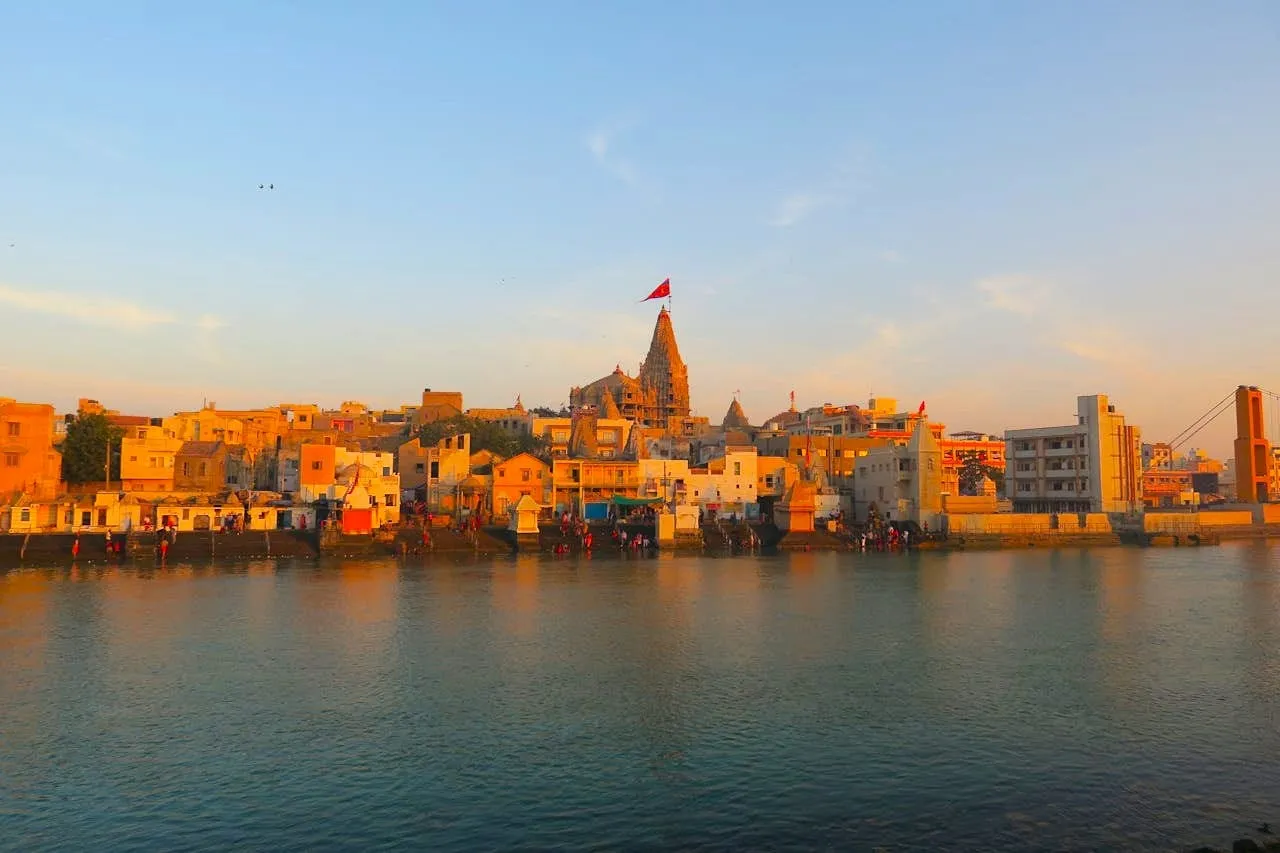
At the centre of Dwarka stands the Dwarkadhish Temple (Jagat Mandir), believed to have been first built over 2,200 years ago. The phrase "Dev Bhumi" — Land of the Gods — reflects a city where daily flag ceremonies, five daily aartis and Gomti bathing rituals keep that tradition alive. From dawn aarti at the temple to the Gomti meeting the Arabian Sea at Sangam Ghat, you feel it in the lanes pilgrims walk every day.
Spiritual Significance
What Makes Dwarka So Sacred
Char Dham
One of the four sacred pilgrimage sites established by Adi Shankaracharya, representing the western corner of India.
Krishna's Capital
The legendary kingdom of Lord Krishna, built by Vishwakarma after Krishna left Mathura.
Submerged City
Marine archaeology has found underwater structures supporting the legend of the sunken Dwarka.
Moksha Dwar
The name itself means "gateway" — many believe a sincere pilgrimage here brings spiritual merit and peace of mind.
Our Mission
Devbhumi Dwarka is an independent travel guide published by ADH Web. We are not affiliated with the Dwarkadhish Temple trust, Gujarat Tourism, or any government body. We do not sell tours, take booking commissions, or rank hotels for payment. Every guide is written to help you plan darshan, transport, and stays on your own terms.
We built this site to give pilgrims and visitors straightforward, reliable information about Dwarka — the Dwarkadhish Temple, Bet Dwarka, Nageshwar Jyotirlinga, darshan timings, how to get here, where to stay, festivals and day-to-day travel tips. No booking commissions, no fluff: just what helps you plan a visit that goes smoothly.
Who writes these guides
Dharmendra Hadiyal leads editorial. He grew up in Saurashtra and has covered Dwarka and Gujarat pilgrimage routes for years — checking train timings at DWK station, walking Gomti Ghat at dawn, and noting what actually changes during Janmashtami versus an ordinary weekday. When temple rules or ferry schedules shift, we update the relevant page and note the change date at the top.
How we verify information
Before publishing, we cross-check darshan hours against temple notice boards, confirm ferry and bridge access with recent pilgrim reports, and compare train times on the Western Railway enquiry. Festival dates follow the Hindu calendar but always deserve a same-day check. If you spot an error, email info@adhweb.com or message us on Instagram — we aim to review corrections within 24–48 hours. Read our full editorial policy.
Whether you're on the Char Dham circuit, coming for the first time, or returning for darshan, we hope these guides save you time and leave you free to focus on the pilgrimage itself. Jai Dwarkadhish.
Lead Editor & Guide
Dharmendra Hadiyal
Travel writer from Saurashtra who covers Dwarka and Gujarat pilgrimage routes.
Written by
Lead Editor & Pilgrimage Guide · Independent Dwarka travel guide
Last updated: August 2026
We verify temple timings, routes, and fares against notice boards and recent pilgrim reports. See our editorial policy.
Frequently Asked Questions
Common Questions About Dwarka
Temple timings, how to get there, what to wear, how much to budget — the things pilgrims ask us most often.
Dwarka is called Devbhumi (Land of the Gods) because according to Hindu tradition, it was established by Lord Krishna as his golden capital and is one of the four sacred Char Dham pilgrimage sites.
Hindu scriptures mention that ancient Dwarka submerged into the Arabian Sea after Krishna left his mortal body. Modern marine archaeological findings off the coast have discovered ancient underwater stone structures supporting this legend.
The 8th-century philosopher-saint Adi Shankaracharya established Dwarka as the western pillar of the four Char Dham pilgrimage sites.
Planning Your Trip to Dwarka?
Darshan timings, how to get there, nearby temples, where to stay — we've put it all together so you can focus on the pilgrimage. Jai Dwarkadhish.